Why Family-Office Wealth Needs Three Ledgers
A family office balance sheet looks like one number. Equities, a private fund, a hotel. One family, one wealth total.
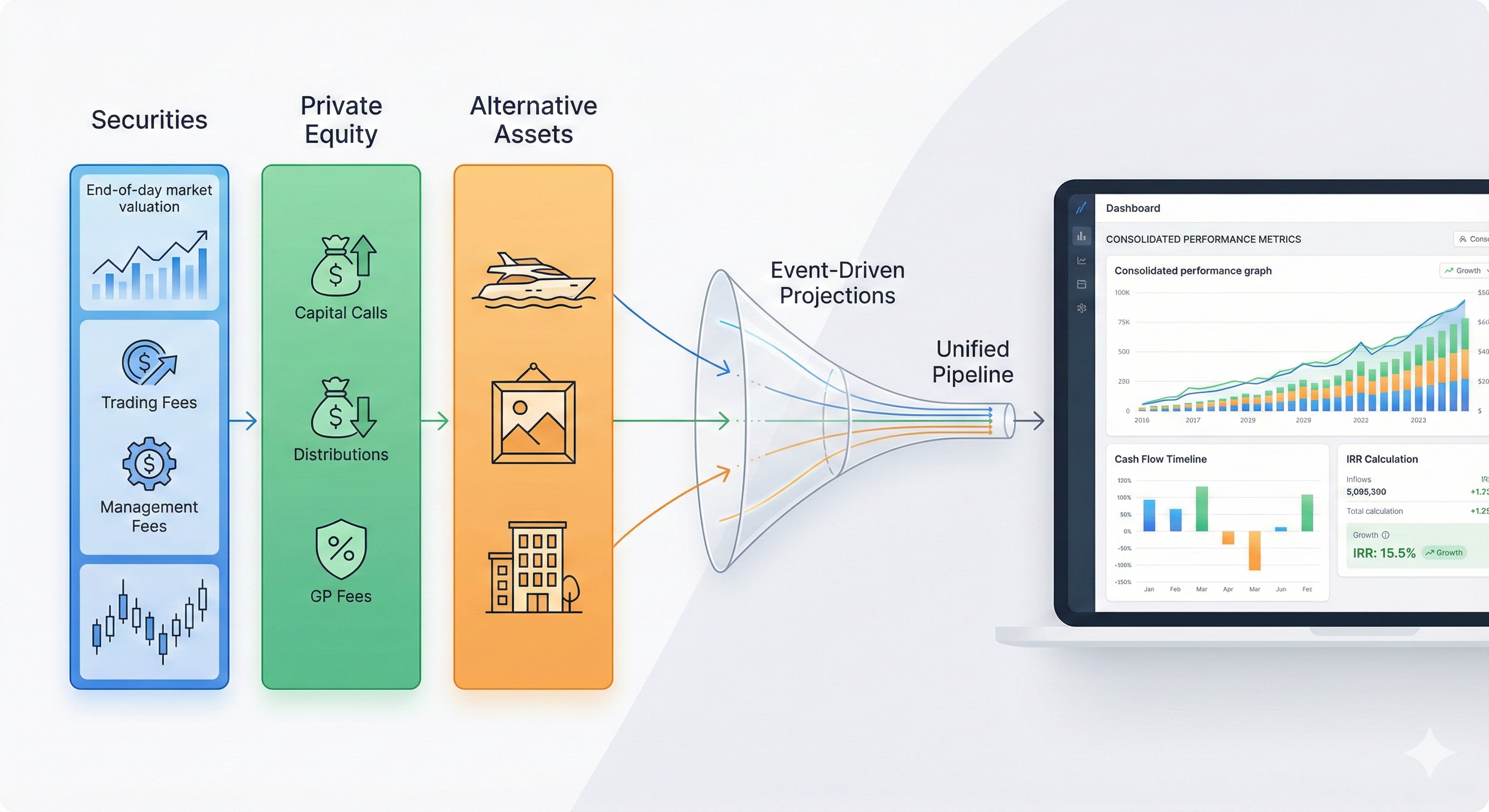
Those three are not one kind of holding. Microsoft is a quantity times a price. The fund is a capital account, and the position is the manager’s net asset value. The hotel has no quantity: the family holds a fraction of an appraisal, after the charges on the building. Treat the fund or the hotel as shares and a capital call, a 60 percent interest, or a gift to a child is booked as a trade.
Quantity x price x size
Tax lots, splits, mergers
Time-weighted return"] PrivateEquity["Private equity ledger
Commitment and calls
Manager NAV on account
Multiples, IRR, J-curve"] RealAssets["Real assets ledger
Fraction of an appraisal
Net of registered charges
Gift and inheritance basis"] Family{"One consolidated
family view?"} Securities --> Family PrivateEquity --> Family RealAssets --> Family style Securities fill:#e7f3ff,stroke:#0066cc,stroke-width:2px style PrivateEquity fill:#d4edda,stroke:#28a745,stroke-width:2px style RealAssets fill:#fff3e0,stroke:#ff9800,stroke-width:2px style Family fill:#ede7f6,stroke:#764ba2,stroke-width:2px
The Securities Ledger: Quantity Times Price
A share of Microsoft is a number of shares and a price. The family buys them. The tax lots carry what was paid. A split or a dividend rewrites the quantity. A merger replaces the holding. A sale closes lots against that cost.
An option or a future is the same kind of holding: a number of contracts, a price, and a contract size. Market value is quantity times price times that size. For Microsoft the size is one. A price exists often enough that a time-weighted return against a benchmark is a fair question.
The Private Equity Ledger: A Capital Account, Not Units
The family does not hold interchangeable units of a private equity fund. They hold a capital account. First a commitment: a promise to pay, not a purchase. Then capital calls: cash leaving against that promise, often years after it was signed. Then distributions: cash coming back, some of it a return of what was paid in, some of it gain.
The position is worth the manager’s net asset value on that account. What a limited partner asks next is how much has been called, how much has come back, and the multiples and the since-inception IRR that fall out of that history. The J-curve is that history drawn over time.
A capital call is not a purchase of shares.
The Real Assets Ledger: A Fraction of an Appraisal
The family does not hold a quantity of hotel. They hold a fraction of a building. They buy it, and the basis is the price plus the buying costs that are capitalised. The mortgage is not part of that basis. A capital improvement adds to what they paid. A repair does not.
An appraisal says what the whole building is worth on the day the valuer struck it. The family’s figure is that appraisal, after the charges registered on the property, times the fraction they hold. Own 60 percent and the other 40 percent is not theirs. If there is no appraisal, or the one on file is too old to state as fair, the figure stays blank or is carried at cost. It is not entered as zero.
Giving a slice to a child moves that fraction and carries the basis across. Inheritance moves the holding and steps the basis up to the value at death. Neither is a sale, and neither realises a gain. Only a sale does. While the hotel is trading, the operating year sits beside the building: the stage of the business, and the period’s result. That record belongs to the property. It is not a fill in the brokerage book.
| Holding | What the family owns | How it is valued | Questions it answers |
|---|---|---|---|
| Microsoft shares | A quantity of interchangeable units | Quantity × price × contract size | Time-weighted return, benchmark attribution |
| Private equity fund | A capital account | Manager’s NAV on the account | Called, distributed, multiples, since-inception IRR |
| Hotel | A fraction of a building | Appraisal net of charges × fraction held | Is the appraisal in date? What is the basis? |
Why One Model Fails
Force the three into one model and every new asset arrives as an exception inside the securities engine. Quantity becomes optional. Price becomes optional. “Sell” starts to mean a gift, a death, a dilution, and a disposal.
The first fractional interest, the first stale appraisal, and the first capital call each show up later as a number nobody can explain. A partnership multiple averaged with an equity time-weighted return is one of those numbers. So is a villa counted twice because two parts of the system both believed they owned it.
Three Bounded Contexts, Three Local Languages
Giving each valuation primitive its own bounded context keeps the language local. Securities keep lots, prices, and benchmarks. Private equity keeps the capital account and the partnership measures. Real assets keep the appraisal, the ownership fraction, and a life cycle in which a gift is a gift.
Each book answers its own reports. The hotel page can say whether the appraisal is still in date. The fund page can show the J-curve. The equity page can attribute performance. None of them is asked to pretend it is the others.
One Page for the Family
The family still wants one page. Microsoft, the fund, and 60 percent of the hotel, in one currency, as one wealth. Each book can answer for itself. None of them can answer for the other two.